OpenTipJar Blog • How-to
Make Housekeeping Appreciation Easier to Act On
By OpenTipJar •
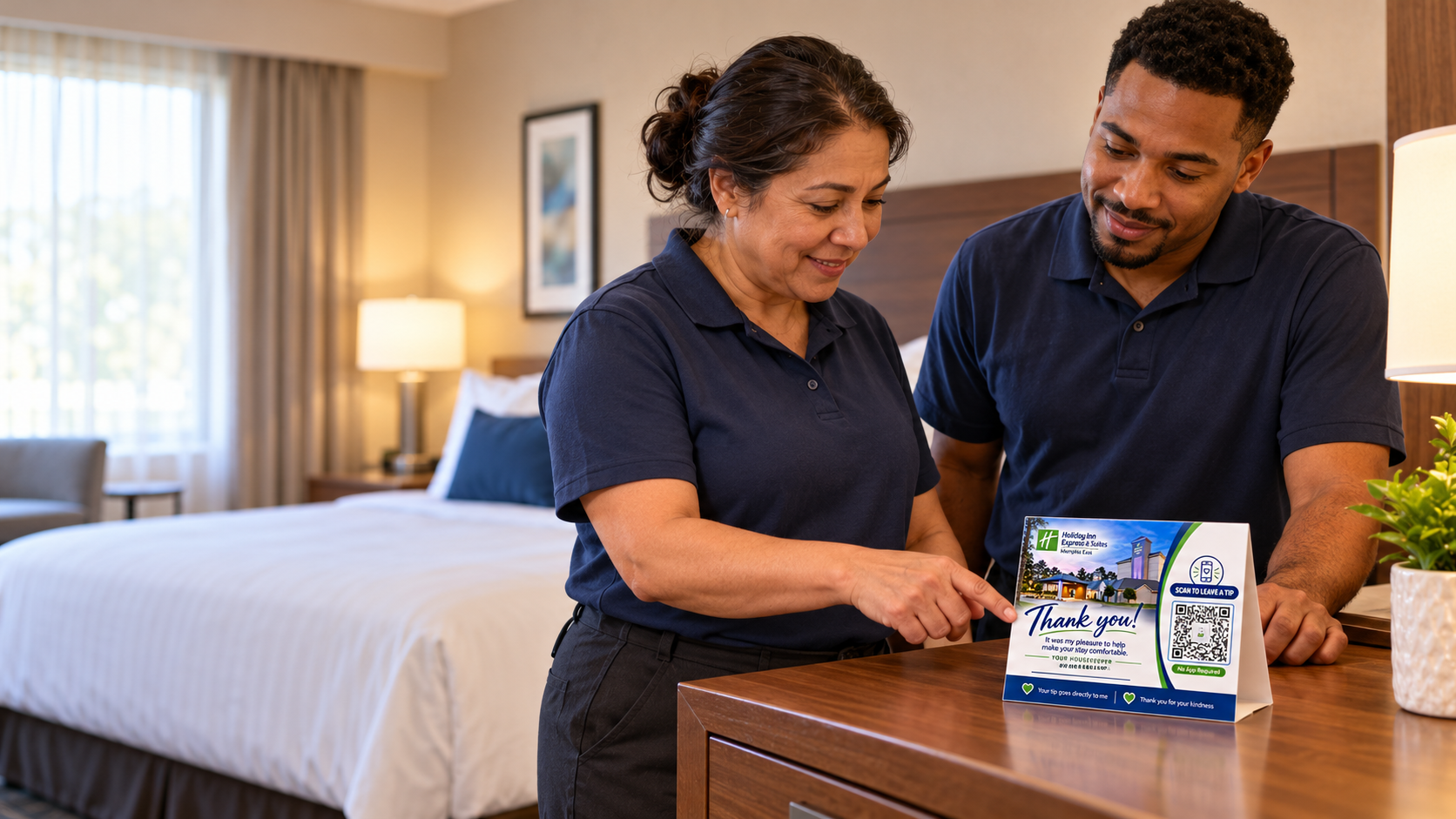
Hotels can make housekeeping appreciation easier by asking employees what works, clearly identifying tip recipients, and giving guests a visible, optional way to tip without cash. The setup should fit the housekeeping routine and explain how tips and fees are handled.
A freshly prepared room reflects someone's work.
The clean bathroom. The carefully made bed. The towels placed where a guest will need them.
A guest may notice those details and want to thank the person behind them. But appreciation does not always lead to action. The guest might have no cash, be unsure who serviced the room, or simply not know how to leave a gratuity.
Hotels can help by making the next step clear.
That starts with the people who prepare the rooms.
Ask housekeeping before choosing the setup
Before approving a tipping card or selecting where to place it, talk with your housekeeping team.
They understand the room-service routine, the materials guests move or overlook, and the practical challenges of keeping recipient information accurate. OpenTipJar does not require room-to-employee assignments in software, and no PMS integration is needed. The usual individual setup lets the housekeeper carry their own card from room to room.
Start with a few questions:
- Will guests know who they are thanking?
- How will the card stay with the person who last serviced the room?
- Would individual tipping or a shared team arrangement fit our team?
- Would an A-frame on a table, or a smaller card with towel art on the bed, fit our room presentation?
These questions help turn a digital tipping idea into a workable process.
For example, a personalized card needs a routine for placement and replacement. A shared card needs a clear explanation of which team receives the tips. Both need staff who understand the arrangement and know where to ask questions.
Include that discussion in planning rather than waiting until the materials arrive. OpenTipJar can help with white-glove configuration, employee onboarding, and complimentary design once the team has chosen an approach.
Give guests a clear recipient
A guest should be able to understand who will receive a tip before making a payment.
For individual tipping, the card can identify the housekeeper associated with it. For a shared setup, the message should explain that the gratuity supports the housekeeping team.
The wording, the QR destination, and the guest-facing page need to agree.
A card that says "Your tip goes directly to me" should not open a team page or an unexplained shared pool. That phrasing also needs a matching setup: the card names that employee, the QR opens that employee's Location, and Auto Share is enabled so the matured net tip is shared to the employee's own OpenTipJar account. A card inviting support for the team should not leave guests assuming they are tipping one named employee.
Review these details together:
| Guest-facing detail | What to check |
|---|---|
| Employee name or team description | Does it identify the intended recipient accurately? |
| QR code or NFC destination | Does it open the correct tipping page? |
| Location profile title | Does the page heading match the card—for example, a named housekeeper rather than "Support Our Housekeeping Team"? |
| Individual or shared wording | Does it match the actual arrangement? |
| Card placement routine | Will recipient information stay accurate when a different employee services the room? |
Clear recipients help guests make an informed choice. They also give employees a shared understanding of how the system is meant to work.
Make the card part of the housekeeping routine
A tipping card needs an operational home as well as a physical one.
Decide who places it, when it is checked, and what happens when a different employee services the room.
One approach is a personalized A-frame or business card that moves with the housekeeper. After servicing a room, the employee leaves their own card and replaces the previous one. That card's QR code opens a hotel Location linked to the employee's independently owned OpenTipJar account. The hotel keeps reporting for activity from that Location; it does not need to map rooms each day. See the employee-linked housekeeping setup guide.
A shared arrangement uses a different routine: keep the team description accurate, and review Share Group membership when staffing changes. Auto Share then splits each matured net tip evenly among the group's current eligible members. A shared card can usually stay in the room.
Room-based Locations are available if a property wants room-level reporting or assignment-based pooling. That is a different operational choice, not the default housekeeping path. See how hotel tips can flow through OpenTipJar.
Choose the approach your team can maintain consistently. A clear, repeatable process is more useful than an elaborate setup that is difficult to keep current.
Put the invitation where guests can find it
Walk through a room as a guest preparing to leave—or to turn in for the night.
Where would you notice a housekeeping thank-you card? Can you read it without picking through other materials? Is the QR code easy to scan in the room's lighting?
A nightstand or dresser may be a practical starting point, depending on the room layout. Avoid placing the card where it competes with too many notices or is likely to be covered by luggage.
Some hotels prefer a smaller format. Instead of an A-frame on a table, the housekeeper places a named business card with the towel art on the bed—propped against it or slipped into a fold. The thinking is simple: a guest who moves the towel art at bedtime is more likely to notice the card than a sign sitting among other room materials.
That approach only works if housekeeping wants to maintain it. Towel art is extra work. If the team already folds a decorative piece, a small card can ride along. If they do not, this format may add time they cannot spare. Discuss it with the team before treating it as the standard. The QR code, recipient name, and optional language stay the same; only the printed piece and its place in the room change.
Complimentary design can produce either an A-frame or a named housekeeping business card against the same Location QR code.
Test the actual printed piece in the actual room:
- Stand or sit where a guest would encounter it.
- Read the message at a comfortable distance.
- Scan the code using a phone.
- Confirm the destination, recipient, and Location profile title.
- Check that folds, holders, or glare do not obstruct the code.
- If you use a business card on the bed, confirm a guest can read the name and scan the code after picking the card up.
If the material offers tap-to-tip, test the NFC-enabled item too. A printed QR card does not provide NFC functionality unless the necessary hardware is included. Housekeeping pieces are usually named A-frame or business cards with a QR code; tap-to-tip is more typical of acrylic signs in shared spaces.
Use a warm invitation that keeps tipping optional
The purpose of the card is to give a willing guest a way to act.
Keep the language friendly and direct:
Want to say thank you? Here's an optional way.
A short message can acknowledge the stay, identify the recipient, and explain how to open the tipping page. It does not need to suggest that a gratuity is required.
Avoid guilt, pressure, or promises about how a particular tip will affect an employee's life. Let the guest decide whether to tip and how much to give.
Housekeeping appreciation also extends beyond gratuities. Fair pay, appropriate staffing, respectful treatment, and recognition from management remain part of supporting the team. An optional tipping channel belongs alongside those practices.
Remove unnecessary steps for cashless guests
Once a guest decides to tip, make the path understandable.
With OpenTipJar, guests can scan a QR code or tap an NFC-enabled item. The Location page shows who they are recognizing, along with the hotel. They choose a displayed amount or enter a custom tip, then complete payment with Apple Pay, Google Pay, or a card. They do not need to download a guest app or create an account. See how guests can tip housekeeping without cash.
Explain that process on the card without crowding it:
Scan or tap. Choose an amount. Pay.
Use hotel-branded materials so the invitation fits the property. OpenTipJar includes complimentary design and print-ready files. Hotels can print locally or order finished materials through OpenTipJar, with no print contract.
Keep the main message readable, leave room around the QR code, and review the design with housekeeping before putting it into service.
Explain fees to staff as clearly as you explain tipping to guests
Employees should understand the difference between the amount a guest tips and the amount remaining after transaction fees.
OpenTipJar's pricing is straightforward:
Cost for Hotel: $0.00
There is no monthly subscription. OpenTipJar deducts its all-in 5% + $0.40 transaction fee, including payment processing, directly from each tip. The hotel is never billed or invoiced for those fees, and there is no guest surcharge.
For an illustrative $10 tip:
| Item | Amount |
|---|---|
| Guest's tip | $10.00 |
| Transaction fee | $0.90 |
| Remaining after the fee | $9.10 |
| Cost for Hotel | $0.00 |
The $9.10 is the amount remaining after the fee and before any sharing allocation. If Auto Share is enabled, that net amount is shared after the three-day hold. It is not an instant bank deposit. Employees then request a payout to a bank account, Venmo, PayPal, Cash App, or instant debit. This example explains the fee; it is not a typical tip amount or an earnings estimate.
Include fee information in employee onboarding so everyone understands the arrangement before launch.
Review the process with your team
After the materials are in use, ask housekeeping what is working and what needs attention.
Are cards easy to carry and place? Are guests asking questions the card should answer? Are recipients clear? Do personalized cards stay with the person who last serviced the room?
Use Analytics to see how the program is working at the property: which cards are being scanned, which Locations have gone quiet, whether staff are linked, and when guests tend to tip. Use reports when you need the raw tipping data—individual transactions you can review or export. Hotel visibility stays tied to activity from your Locations; it does not include unrelated tips in an employee's personal OpenTipJar account. See how hotel Analytics shows what is working.
Avoid treating either view as a staff performance score. A gratuity is a guest's choice, and the amount alone does not establish the quality of someone's work.
Look for practical improvements you can make: clearer wording, better placement, a simpler replacement routine, or another explanation during onboarding.
The goal is to make the opportunity accessible and manageable. Digital tipping does not guarantee a particular income or outcome.
Frequently asked questions
How can hotels make it easier for guests to thank housekeeping?
Ask housekeeping staff what fits their routine, clearly identify who receives tips, and provide a visible, optional tipping method. For guests without cash, a hotel-provided QR code or NFC-enabled item can open a tipping page where they choose an amount and pay.
What should a housekeeping tipping card say?
A useful card includes a brief thank-you, an accurate employee or team description, a simple instruction, and a clear indication that tipping is optional. The recipient wording should match the Location QR code and the guest-facing tipping page.
Should housekeeping tips go to an individual or a shared team?
That depends on the hotel's arrangement. Discuss the options with staff, explain recipients and sharing clearly, and follow the requirements that apply to your property. OpenTipJar does not set payroll, tax, or tip-pooling policy. For individual tipping, a named employee Location can Auto Share the matured net tip to that person's account. For a shared team, a Share Group evenly splits each matured net tip among current eligible members. The card should accurately describe the chosen setup.
Where should a hotel place a housekeeping tipping card?
Choose a visible, uncluttered location that fits the room. An A-frame on a nightstand or dresser is a common starting point. Some hotels place a smaller named business card with towel art on the bed so guests notice it when they turn in. Test readability and scanning in the room's lighting, and ask housekeeping whether the placement is practical to maintain.
Should housekeeping use an A-frame card or a business card?
Either format can use the same employee or team Location QR code. An A-frame on a table is easy to leave in place. A business card paired with towel art on the bed can catch attention when a guest moves the towels. Ask the team which format they can maintain, then test that the name is readable and the QR code scans.
Does a hotel pay OpenTipJar's transaction fees?
No. Cost for Hotel: $0.00. OpenTipJar deducts its all-in 5% + $0.40 fee, including payment processing, directly from each tip transaction. The hotel is never billed or invoiced for those fees, and guests do not pay a surcharge.
Keep appreciation easy to act on
A thoughtful housekeeping tipping setup begins with listening.
Ask the team. Make recipients clear. Place the invitation where guests can find it. Explain the fees and keep the choice voluntary.
Those steps give guests who want to say thank you an understandable way to do it.
Explore OpenTipJar for hotels to plan a setup that fits your property and your housekeeping team.
Make housekeeping appreciation easier to act on
No monthly subscription, complimentary hotel-branded materials, and a guest experience that works from a phone—no app required.
Questions about hotel setup or tipping cards? support@opentipjar.com