OpenTipJar Blog • Digital Tipping
The Psychology of Digital Tipping: Why People Choose $5, $10, or $20
By OpenTipJar •
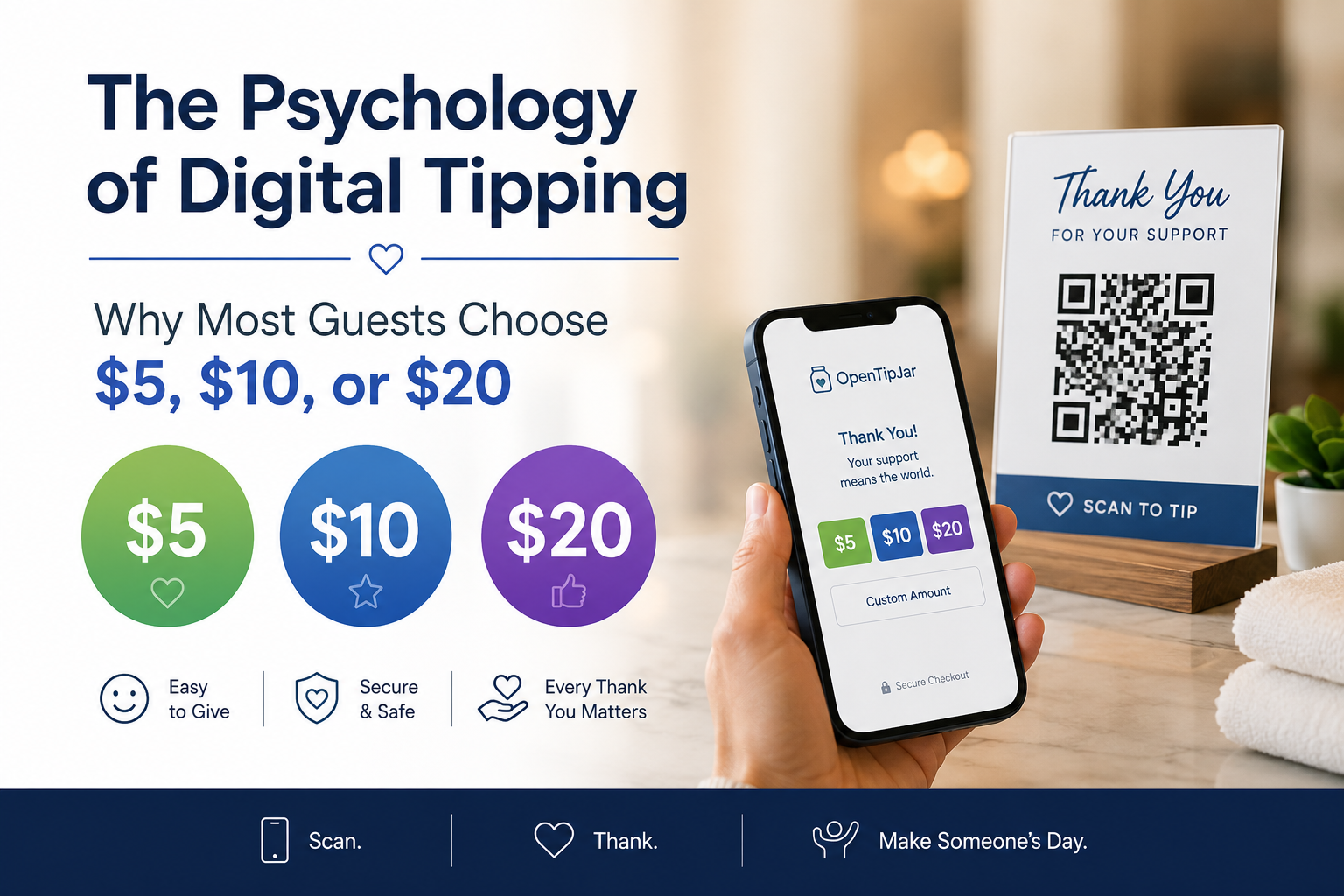
People often choose $5, $10, or $20 when leaving a digital tip because these amounts are familiar, easy to evaluate, and meaningful without requiring a complicated calculation. When the payment process is quick and the suggested amounts feel appropriate, guests can act on their gratitude with less hesitation.
At OpenTipJar, we see this pattern across different types of digital tipping and donation experiences. The setting may change, but people repeatedly gravitate toward a small group of familiar dollar amounts.
That behavior offers an important lesson for hotels, restaurants, service businesses, musicians, community organizations, and anyone considering a digital tip jar:
The easier it is to decide how much to give, the easier it is to complete the tip.
Why Are $5, $10, and $20 Common Digital Tip Amounts?
These amounts work well because they occupy a practical middle ground.
They are:
- Large enough to feel meaningful
- Small enough to choose quickly
- Familiar from everyday cash transactions
- Easy to compare without doing mental math
- Appropriate across many service and donation situations
A guest does not need to calculate a percentage, remember the price of a service, or search for exact change. They can simply select the amount that best matches how they feel.
Digital Tipping Is Often an Expression of Gratitude, Not a Calculation
Traditional restaurant tipping is usually connected to a bill. A customer may calculate 18%, 20%, or another percentage based on the total.
Many digital tipping situations are different.
A guest may want to thank:
- A hotel housekeeping team
- A marina dockhand
- A valet or bell attendant
- A musician or performer
- A tour guide
- A service professional
- A group of volunteers
- A community organization
In these situations, there may be no bill to use as a reference point. The person is not asking, "What percentage should I leave?"
They are asking:
"What amount feels like an appropriate thank-you?"
For many people, $5 feels thoughtful and accessible. A $10 tip may reflect stronger appreciation. A $20 tip can communicate that the service or experience felt especially valuable.
Familiar Amounts Reduce Decision Friction
Every extra decision in a payment flow creates an opportunity for hesitation.
A visitor who sees a blank amount field must decide what to enter. They may wonder whether their amount is too small, too large, or unusual. Even a generous person can abandon the process when the decision feels awkward.
Suggested tip amounts reduce that uncertainty.
Instead of inventing a number, the guest can choose from several socially familiar options. A custom amount should still be available, but it does not need to be the only path.
This is one reason a well-designed digital tipping page can be more effective than simply displaying a QR code tip jar connected to a generic payment form.
The page helps answer three questions immediately:
- Who will receive the tip?
- What amounts are reasonable?
- How quickly can I complete it?
Why Convenience Changes Tipping Behavior
Many people want to leave a tip but do not carry cash.
This is especially common in hotels, marinas, events, and other settings where the opportunity to tip may occur away from a traditional checkout counter.
A guest may appreciate the service but have no bills available. Without a digital option, that intended tip may never happen.
QR code and NFC tipping remove the cash barrier. A guest can scan or tap, select an amount, and pay from a phone they already have with them—the same idea behind cashless tipping.
The technology does not create gratitude. It gives people a convenient way to act on gratitude that already exists.
The Role of Suggested Tip Amounts
Suggested amounts can help guests make faster decisions, but they need to fit the situation.
For many digital tipping experiences, a range such as $5, $10, and $20 feels natural because each amount represents a different level of appreciation.
| Suggested amount | How it may feel to the guest |
|---|---|
| $5 | A simple, thoughtful thank-you |
| $10 | Meaningful appreciation for good service |
| $20 | Strong recognition for an exceptional experience |
| Custom | Flexibility for any other amount |
These are not rules. The right choices depend on the type of service, the audience, and the context.
The goal is not to pressure anyone into selecting a larger amount. The goal is to make the decision comfortable and clear.
Do Suggested Tip Amounts Pressure Guests?
They should not.
A good digital tipping experience should make appreciation easier without making the guest feel obligated—unlike the awkward prompts many people associate with POS tip screens.
That means:
- The sign or payment page should use respectful language.
- The recipient of the tip should be clearly identified.
- A custom amount should remain available.
- The guest should be able to leave without completing a payment.
- The experience should not rely on guilt, urgency, or confusing defaults.
Digital tipping works best when it feels optional, transparent, and easy.
What Businesses Can Learn From Digital Tipping Behavior
Organizations do not need to create a complicated system to encourage digital tips. In most cases, clarity and convenience matter more than the number of features.
1. Use familiar suggested amounts
Offer a small group of recognizable choices rather than a long list of amounts. Too many options can make the decision harder.
2. Explain who receives the tip
Guests are more comfortable giving when they understand whether the money supports an individual, a department, a shared team, or an organization. That clarity also supports sharing tips with your team.
3. Keep the payment flow short
Avoid unnecessary forms, account creation, or multiple screens before payment. Every additional step creates friction.
4. Support both QR codes and NFC
Some guests prefer to scan. Others prefer to tap. Offering both lets the guest use whichever action feels easiest.
5. Allow custom tips
Suggested amounts provide guidance, but guests should always be able to choose another amount.
6. Place the tipping option where gratitude occurs
A digital tip prompt is most relevant near the moment the guest recognizes good service. Examples include a hotel room, marina fuel dock, performance area, service counter, or event donation station. Multi-location teams can also track tips and donations by location.
What Is the Best Default Amount for a Digital Tip Jar?
There is no single amount that works for every business.
However, a useful starting point is to offer three familiar choices that represent modest, standard, and generous appreciation. For many use cases, $5, $10, and $20 provide that range.
Lower-priced or high-frequency settings may benefit from smaller options. Premium hospitality or specialized service settings may justify higher choices.
The best amounts are the ones that feel natural for the experience and respectful to the guest.
Are Digital Tips Usually Larger Than Cash Tips?
Digital payments can make larger amounts easier to leave because the guest is not limited by the bills in a wallet.
However, tip size varies by industry, service quality, placement, audience, and timing. A digital system should not be presented as a guarantee of larger tips.
Its primary advantage is accessibility: it gives someone a way to tip when cash is unavailable—one reason many businesses compare an electronic tip jar vs. a cash tip jar.
Why Digital Tipping Matters for Hotels and Service Businesses
Cashless behavior has created a gap between a guest's intention and ability to tip.
A hotel guest may want to recognize housekeeping but have no cash in the room. A marina customer may want to thank a dockhand after fueling but leave before visiting an ATM. An event attendee may feel inspired to donate but have no bills available.
Digital tipping closes that gap.
It allows organizations to provide a clear, modern way for guests to recognize the people who helped create a positive experience. Hotels can learn more about digital tipping for hotels, or explore cashless tipping for hospitality teams.
Frequently Asked Questions
Why do people choose round numbers when tipping digitally?
Round numbers are familiar and quick to evaluate. Amounts such as $5, $10, and $20 let people make a decision without calculating percentages or entering an exact figure.
What suggested tip amounts should a digital tip jar offer?
The amounts should match the service and audience. For many hospitality, service, and event settings, $5, $10, and $20 are a practical starting point, with a custom amount available.
Should a digital tip jar include a custom amount?
Yes. Suggested amounts make the process easier, while a custom option gives guests full control.
Do QR code tip jars work when guests do not carry cash?
That is one of their main benefits. A guest can scan a QR code or tap an NFC-enabled sign and complete the tip from a mobile device.
Can digital tips be shared across a team?
Yes. Depending on the platform and the organization's policies, digital tips may be directed to an individual, tracked by location, or collected for distribution across a team.
Are digital tip jars only for restaurants?
No. Digital tipping can support hotels, housekeeping teams, marinas, musicians, salons, service professionals, events, community fundraisers, and many other use cases.
The Bottom Line
People do not usually want to overthink a thank-you.
They want to choose an amount that feels familiar, appropriate, and meaningful, then complete the payment without unnecessary friction.
That is why $5, $10, and $20 appear so naturally in digital tipping experiences. The amounts are easy to understand, flexible enough for different levels of appreciation, and familiar to almost everyone.
At OpenTipJar, we designed the tipping experience around that simple idea. Guests can tap or scan, select an amount, and turn appreciation into action without needing cash.
Create an OpenTipJar page or learn more about digital tipping for hotels.
Create your free digital tip jar
Offer familiar tip amounts, download a QR code, and give guests an easy way to say thank you—no cash required.